Nonprofit Content Calendar: A Realistic Guide for One-Person Comms Teams

For organizations building digital presence for healthcare B2B firms, the assumption that authority requires large advertising budgets is a costly myth. Behavioral insights digital marketing research consistently shows that credibility compounds through strategic clarity and consistent communication, not spend. This post outlines how mission-driven organizations in healthcare, public health, and consulting are building enduring digital authority through precision rather than volume.

Subscribe to our newsletter

You start the month with a clear plan. You have the story ideas, the grant reporting language queued up, and a genuine commitment to post on social media at least three times each week. Then the week actually begins.

A coalition partner needs urgent advocacy support. A community event requires your full presence. A funder asks for a one-page program update with two days’ notice. And just like that, your nonprofit content calendar becomes a casualty of the very work you are trying to communicate about.

For coalition communications coordinators and nonprofit outreach managers operating as a team of one, this is not an occasional disruption. It is the operational reality of the sector. And the most direct consequence is not a missed post. It is the slow erosion of the consistency that community trust depends on.


Your audience experiences every gap in your communications as a signal. Silence reads as absence, even when your team is doing its most important work.

This guide walks through a sustainable approach to nonprofit communications planning: one built for the capacity you actually have, not the capacity a large agency might assume.
slds communication for nonprofit

The True Cost of Capacity Strain in Nonprofit Communications

Nonprofit communicators are among the most resourceful professionals in any sector. The challenge they face is not a lack of skill, creativity, or commitment. It is a structural one, and the data confirms it.

According to the Nonprofit Marketing Guide's annual Communications Trends Reports, capacity and workload, not content ideas, are the top obstacle nonprofit communicators report year over year. The challenge is structural, not creative.

That capacity strain does not exist in isolation. It compounds with funding uncertainty, which makes adding communications staff feel out of reach even when the need is clear. It layers on top of staffing difficulty across the broader organization, where hiring and retention challenges in program delivery pull leadership attention away from communications infrastructure.

The Center for Effective Philanthropy's State of Nonprofits 2025 report found that staffing difficulties and funding uncertainty compound simultaneously across the sector: nearly two thirds of nonprofit leaders reported difficulty filling vacancies, and more than half cited insufficient funding to maintain current staffing levels.

For a coalition Executive Director managing program delivery, funder relationships, board obligations, and community partnerships simultaneously, asking one outreach coordinator to also own the full digital communications strategy is not a temporary workaround. It is the standard operating model. And it is one that breaks down predictably, not through failure of effort, but through the mathematics of hours available.

What Reactive Communications Actually Costs Your Coalition

When communications become reactive, meaningful content goes out only when there is time, the pattern is consistent: bursts of activity followed by extended silence. Your audience sees this cycle, even if they cannot name it.

The problem with inconsistency is not aesthetic. In mission-driven public health communications, consistency is the mechanism through which credibility accumulates. Communities do not build trust with organizations they hear from intermittently. They build trust with organizations that are reliably present.

Reactive communications also makes it significantly harder to justify your digital outreach investment to funders and boards. When a grant reporting cycle arrives and your analytics show sporadic engagement over uneven posting periods, the data does not reflect the quality or importance of the work. It reflects the capacity constraints that shaped when content was published. Those are two very different stories, and funders need to hear the right one.

There is also the question of misinformation. The Nonprofit Marketing Guide’s 2025 Communications Trends Report found that email, in-person events, and websites consistently outperform social media channels in effectiveness, and that social media alone is not sufficient to protect your coalition’s information environment. When your coalition goes quiet, that space is filled by other voices, including sources actively undermining the evidence-based messages your coalition exists to deliver.

Reframing the Goal: Cadence Over Volume

The most consequential shift a one-person nonprofit comms team can make is not adding more channels, producing more content, or experimenting with new formats. It is reframing the definition of success from volume to cadence.


An enduring nonprofit content calendar has one job: to survive your busiest month without going silent.

A sustainable social media plan for nonprofits is not a smaller version of a large agency’s content calendar. It is a structurally different plan, built around the actual time available and designed so that every piece of content supports every other piece. Nothing carries the full weight of your communications alone.

When you build for cadence, you also build resilience. A team of one can maintain a cadence-based content structure through a grant deadline, a staff transition, or a particularly demanding program period, because the structure does not require ideal conditions to hold. It requires a clear system and a realistic publishing rhythm that the organization can actually sustain.
slds enduring nonprofit content calendar

Reframing the Goal: Cadence Over Volume

Rather than generating original content from scratch across multiple platforms and channels each week, a sustainable coalition communications strategy anchors everything on a single monthly asset and builds outward from it.

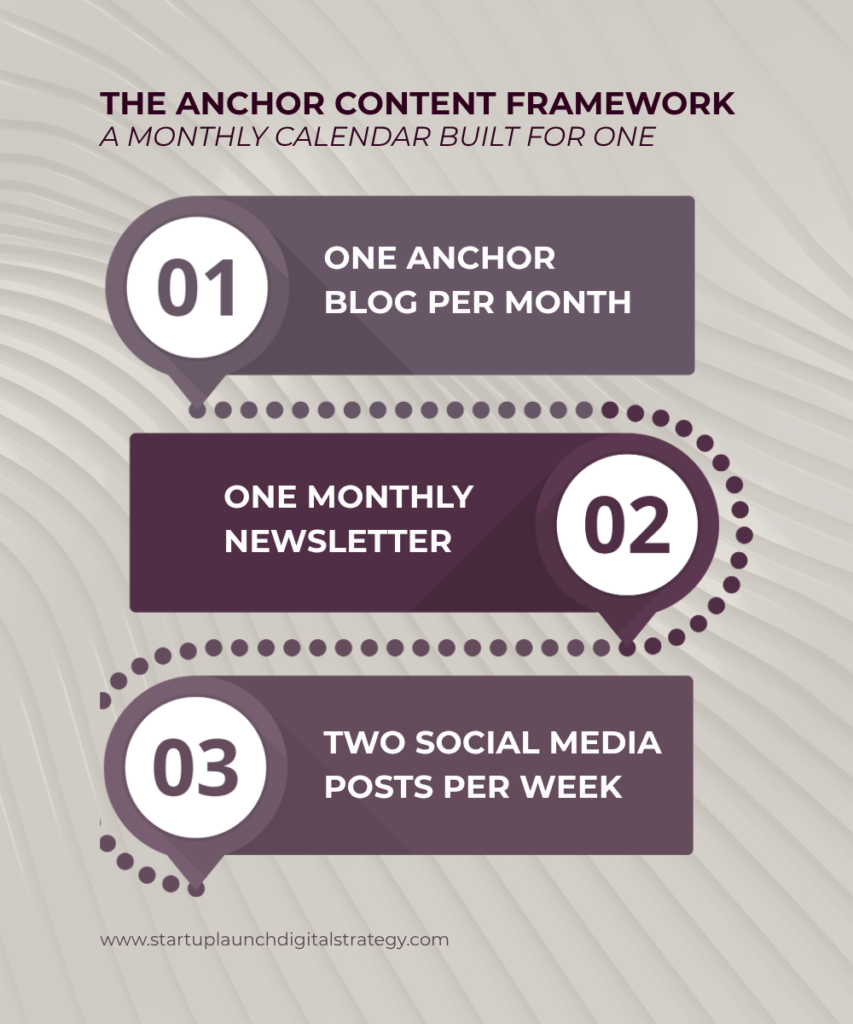
Here is the framework SLDS recommends for one-person nonprofit comms teams:


One Anchor Blog Per Month. One substantive, evidence-grounded piece of long-form content focused on a core coalition priority. This article becomes the authoritative source your other content points back to. It is also the content most likely to support your SEO strategy for nonprofit organizations, since search engines reward sustained, topic-specific depth over high-frequency, shallow posting.


One Monthly Newsletter. Your newsletter is not a separate content production effort. It is a distribution layer for the work you have already done. Feature your anchor blog as the lead, surround it with a brief program update or partner highlight, and close with a single clear call to action. Your newsletter list is the most direct line to the funders, coalition members, and community partners who need to see that your organization is active and credible.


Two Social Posts Per Week. Each social post is extracted directly from your anchor blog. A key statistic becomes one post. A central framework or takeaway becomes another. Rather than treating social media as a separate content stream requiring separate ideation, treat it as a repurposing layer on top of the anchor content you have already produced. This approach means your anchor blog effectively generates your newsletter and up to eight social media posts. No single piece of content carries the full communications weight of your organization alone.


This framework is not a compromise or a minimum viable approach. It is a precision strategy designed for the organizational reality of grant-funded communications. It is also the structure that allows data to accumulate meaningfully across reporting periods, because the content is consistent, thematic, and trackable in ways that reactive posting never is.
 

slds content framework

Practical First Steps for Coalitions With No Current System

If your coalition currently operates without a structured communications calendar, the path forward is sequential, not simultaneous. Attempting to build out every channel and asset type at once is the most common reason sustainable systems fail before they start.

Begin with two steps only:


  • Choose one shared theme for the upcoming month. This is the organizing concept for every piece of content you produce in that period. It does not have to be elaborate. A single program priority, a health observance relevant to your coalition’s mission, or a recurring grant-cycle topic is sufficient. The discipline is in committing to one theme and returning to it across every asset, rather than producing disconnected posts on different topics each week.
  • Map that theme across the touchpoints you already use. Before considering any new channels or formats, trace how your single theme can move through your existing newsletter, your existing social accounts, and any upcoming events or funder communications. Most coalitions will find they already have the infrastructure to execute this framework. What they lack is the organizing logic that connects the pieces.


From that foundation, the system becomes self-reinforcing. A theme produces an anchor blog. The anchor blog produces the newsletter. The newsletter produces social posts. The posts build toward the next grant reporting cycle with consistent, attributable data. And the cycle begins again the following month with a new theme, a new anchor, and no blank page to face.

A Note on Metrics: What Funders Actually Need to See

One of the most underaddressed pain points in nonprofit social media planning is the translation problem between digital engagement metrics and the outcome language funders use and care about. The Center for Effective Philanthropy’s State of Nonprofits 2025 report found that nonprofit leaders face persistent pressure to demonstrate impact while navigating ongoing financial uncertainty. A sustainable communications system that does not account for this gap will produce data that is genuinely difficult to defend in a grant report, even if the underlying communications work has been excellent.

The anchor content framework addresses this in two structural ways. First, consistent thematic content allows you to track engagement over time on specific public health topics, which is far more defensible than aggregate account metrics. Second, the blog and newsletter infrastructure creates a documented record of educational outreach activity with measurable audience reach, which maps more cleanly to the program delivery language most funders expect to see.

Building this infrastructure now means that when the next reporting cycle arrives, your communications data tells a coherent story about consistent, mission-aligned outreach rather than a series of disconnected data points.

Build the Foundation Before the Pressure Arrives

A sustainable nonprofit content calendar is not built during your busiest grant period. It is built in advance of it, so that when program delivery demands everything your team has, your communications continue to reflect the credibility and consistency your coalition has earned.

At SLDS, we build content planning systems designed specifically for lean, mission-driven organizations. Our approach is scoped to the actual capacity of the team in front of us, not an idealized version of what communications infrastructure could look like with unlimited resources. The result is an enduring structure that holds through staffing changes, budget cycles, and the months when program delivery has to come first.

If your coalition is ready to move from reactive to resilient, we would welcome a conversation about what a scoped content planning system looks like for your organization.

Sources

Liked this post? Share with others!

Ready to build a digital foundation that compounds?

Book a Free 30-Minute Strategy Session
 
Our team specializes in digital strategy for healthcare consulting firms, public health organizations, and mission-driven nonprofits. Let’s align your digital presence with the credibility your work deserves.

You start the month with a clear plan. You have the story ideas, the grant reporting language queued up, and a genuine commitment to post on social media at least three times each week. Then the week actually begins.

A coalition partner needs urgent advocacy support. A community event requires your full presence. A funder asks for a one-page program update with two days’ notice. And just like that, your nonprofit content calendar becomes a casualty of the very work you are trying to communicate about.

For coalition communications coordinators and nonprofit outreach managers operating as a team of one, this is not an occasional disruption. It is the operational reality of the sector. And the most direct consequence is not a missed post. It is the slow erosion of the consistency that community trust depends on.


Your audience experiences every gap in your communications as a signal. Silence reads as absence, even when your team is doing its most important work.

This guide walks through a sustainable approach to nonprofit communications planning: one built for the capacity you actually have, not the capacity a large agency might assume.

slds communication for nonprofit

The True Cost of Capacity Strain in Nonprofit Communications

Nonprofit communicators are among the most resourceful professionals in any sector. The challenge they face is not a lack of skill, creativity, or commitment. It is a structural one, and the data confirms it.

According to the Nonprofit Marketing Guide's annual Communications Trends Reports, capacity and workload, not content ideas, are the top obstacle nonprofit communicators report year over year. The challenge is structural, not creative.

That capacity strain does not exist in isolation. It compounds with funding uncertainty, which makes adding communications staff feel out of reach even when the need is clear. It layers on top of staffing difficulty across the broader organization, where hiring and retention challenges in program delivery pull leadership attention away from communications infrastructure.

The Center for Effective Philanthropy's State of Nonprofits 2025 report found that staffing difficulties and funding uncertainty compound simultaneously across the sector: nearly two thirds of nonprofit leaders reported difficulty filling vacancies, and more than half cited insufficient funding to maintain current staffing levels.

For a coalition Executive Director managing program delivery, funder relationships, board obligations, and community partnerships simultaneously, asking one outreach coordinator to also own the full digital communications strategy is not a temporary workaround. It is the standard operating model. And it is one that breaks down predictably, not through failure of effort, but through the mathematics of hours available.

What Reactive Communications Actually Costs Your Coalition

When communications become reactive, meaningful content goes out only when there is time, the pattern is consistent: bursts of activity followed by extended silence. Your audience sees this cycle, even if they cannot name it.

The problem with inconsistency is not aesthetic. In mission-driven public health communications, consistency is the mechanism through which credibility accumulates. Communities do not build trust with organizations they hear from intermittently. They build trust with organizations that are reliably present.

Reactive communications also makes it significantly harder to justify your digital outreach investment to funders and boards. When a grant reporting cycle arrives and your analytics show sporadic engagement over uneven posting periods, the data does not reflect the quality or importance of the work. It reflects the capacity constraints that shaped when content was published. Those are two very different stories, and funders need to hear the right one.

There is also the question of misinformation. The Nonprofit Marketing Guide’s 2025 Communications Trends Report found that email, in-person events, and websites consistently outperform social media channels in effectiveness, and that social media alone is not sufficient to protect your coalition’s information environment. When your coalition goes quiet, that space is filled by other voices, including sources actively undermining the evidence-based messages your coalition exists to deliver.

Reframing the Goal: Cadence Over Volume

The most consequential shift a one-person nonprofit comms team can make is not adding more channels, producing more content, or experimenting with new formats. It is reframing the definition of success from volume to cadence.


An enduring nonprofit content calendar has one job: to survive your busiest month without going silent.

A sustainable social media plan for nonprofits is not a smaller version of a large agency’s content calendar. It is a structurally different plan, built around the actual time available and designed so that every piece of content supports every other piece. Nothing carries the full weight of your communications alone.

When you build for cadence, you also build resilience. A team of one can maintain a cadence-based content structure through a grant deadline, a staff transition, or a particularly demanding program period, because the structure does not require ideal conditions to hold. It requires a clear system and a realistic publishing rhythm that the organization can actually sustain.

slds enduring nonprofit content calendar

Reframing the Goal: Cadence Over Volume

Rather than generating original content from scratch across multiple platforms and channels each week, a sustainable coalition communications strategy anchors everything on a single monthly asset and builds outward from it.

Here is the framework SLDS recommends for one-person nonprofit comms teams:


One Anchor Blog Per Month. One substantive, evidence-grounded piece of long-form content focused on a core coalition priority. This article becomes the authoritative source your other content points back to. It is also the content most likely to support your SEO strategy for nonprofit organizations, since search engines reward sustained, topic-specific depth over high-frequency, shallow posting.


One Monthly Newsletter. Your newsletter is not a separate content production effort. It is a distribution layer for the work you have already done. Feature your anchor blog as the lead, surround it with a brief program update or partner highlight, and close with a single clear call to action. Your newsletter list is the most direct line to the funders, coalition members, and community partners who need to see that your organization is active and credible.


Two Social Posts Per Week. Each social post is extracted directly from your anchor blog. A key statistic becomes one post. A central framework or takeaway becomes another. Rather than treating social media as a separate content stream requiring separate ideation, treat it as a repurposing layer on top of the anchor content you have already produced. This approach means your anchor blog effectively generates your newsletter and up to eight social media posts. No single piece of content carries the full communications weight of your organization alone.


This framework is not a compromise or a minimum viable approach. It is a precision strategy designed for the organizational reality of grant-funded communications. It is also the structure that allows data to accumulate meaningfully across reporting periods, because the content is consistent, thematic, and trackable in ways that reactive posting never is.


slds content framework

Practical First Steps for Coalitions With No Current System

If your coalition currently operates without a structured communications calendar, the path forward is sequential, not simultaneous. Attempting to build out every channel and asset type at once is the most common reason sustainable systems fail before they start.

Begin with two steps only:


  • Choose one shared theme for the upcoming month. This is the organizing concept for every piece of content you produce in that period. It does not have to be elaborate. A single program priority, a health observance relevant to your coalition’s mission, or a recurring grant-cycle topic is sufficient. The discipline is in committing to one theme and returning to it across every asset, rather than producing disconnected posts on different topics each week.
  • Map that theme across the touchpoints you already use. Before considering any new channels or formats, trace how your single theme can move through your existing newsletter, your existing social accounts, and any upcoming events or funder communications. Most coalitions will find they already have the infrastructure to execute this framework. What they lack is the organizing logic that connects the pieces.


From that foundation, the system becomes self-reinforcing. A theme produces an anchor blog. The anchor blog produces the newsletter. The newsletter produces social posts. The posts build toward the next grant reporting cycle with consistent, attributable data. And the cycle begins again the following month with a new theme, a new anchor, and no blank page to face.

A Note on Metrics: What Funders Actually Need to See

One of the most underaddressed pain points in nonprofit social media planning is the translation problem between digital engagement metrics and the outcome language funders use and care about. The Center for Effective Philanthropy’s State of Nonprofits 2025 report found that nonprofit leaders face persistent pressure to demonstrate impact while navigating ongoing financial uncertainty. A sustainable communications system that does not account for this gap will produce data that is genuinely difficult to defend in a grant report, even if the underlying communications work has been excellent.

The anchor content framework addresses this in two structural ways. First, consistent thematic content allows you to track engagement over time on specific public health topics, which is far more defensible than aggregate account metrics. Second, the blog and newsletter infrastructure creates a documented record of educational outreach activity with measurable audience reach, which maps more cleanly to the program delivery language most funders expect to see.

Building this infrastructure now means that when the next reporting cycle arrives, your communications data tells a coherent story about consistent, mission-aligned outreach rather than a series of disconnected data points.

Build the Foundation Before the Pressure Arrives

A sustainable nonprofit content calendar is not built during your busiest grant period. It is built in advance of it, so that when program delivery demands everything your team has, your communications continue to reflect the credibility and consistency your coalition has earned.

At SLDS, we build content planning systems designed specifically for lean, mission-driven organizations. Our approach is scoped to the actual capacity of the team in front of us, not an idealized version of what communications infrastructure could look like with unlimited resources. The result is an enduring structure that holds through staffing changes, budget cycles, and the months when program delivery has to come first.

If your coalition is ready to move from reactive to resilient, we would welcome a conversation about what a scoped content planning system looks like for your organization.

Sources

Learn how we helped 100 top brands gain success