
The landscape of professional authority is shifting. In the current digital climate, data is everywhere—but genuine confidence in that data is a rare commodity. Despite the rise of automated dashboards, a significant gap exists between raw data and meaningful strategy. Research indicates that only about 23% of marketers feel confident they are tracking performance indicators that actually align with their long-term goals (Ruler Analytics, 2024).
For an Expert Strategist or a Community Advocate, this lack of precision is more than a technical hurdle; it is a threat to Enduring Foundations. Relying on “growth hacks” or surface-level “marketing tricks” doesn’t just reduce efficiency—it actively erodes the Credibility and Trust that form the cornerstone of your reputation. At SLDS (Startup Launch Digital Strategy), we believe that every claim must feel backed by strategy and behavioral science. This is why we focus on Precision KPIs: measurement systems that align strategy, customer behavior, and real-world outcomes across the entire journey.
Metrics vs. KPIs: Why the Distinction Matters for Regulated Industries
A foundational principle of our core voice is Authoritative yet Accessible expertise. In this spirit, we must address a common misconception: assuming all metrics are KPIs. They’re not. While all KPIs are metrics, not all metrics are meaningful indicators of success. Many are simply “noise”—surface-level data points or vanity signals that prioritize visibility over credibility.
Consider the difference in strategic intent:
“We posted five times this week” is a metric.
“Our engagement rate generated 30 Mission-Aligned leads” is a KPI.
The difference is strategic intent.
Effective marketing requires tracking both final outcomes and intermediate signals to identify bottlenecks in the customer journey (Ascarza et al., 2026). Without those intermediate signals, organizations cannot understand why performance is changing. In highly regulated environments, we avoid “gatekeeping” with dense jargon, but we never compromise on the depth of our data-informed insights.
Understanding the Marketing Funnel through Behavioral Insights
The marketing funnel represents the customer journey from first awareness to final action. At SLDS, we align this funnel to the specific regulatory pressures and trust-based goals our clients face — informed by behavioral insights digital marketing principles:
Awareness: Recognition and Scaling Influence.
Consideration: Evaluation and building Patient and Provider Trust.
Decision: Mission-Aligned action and conversion.
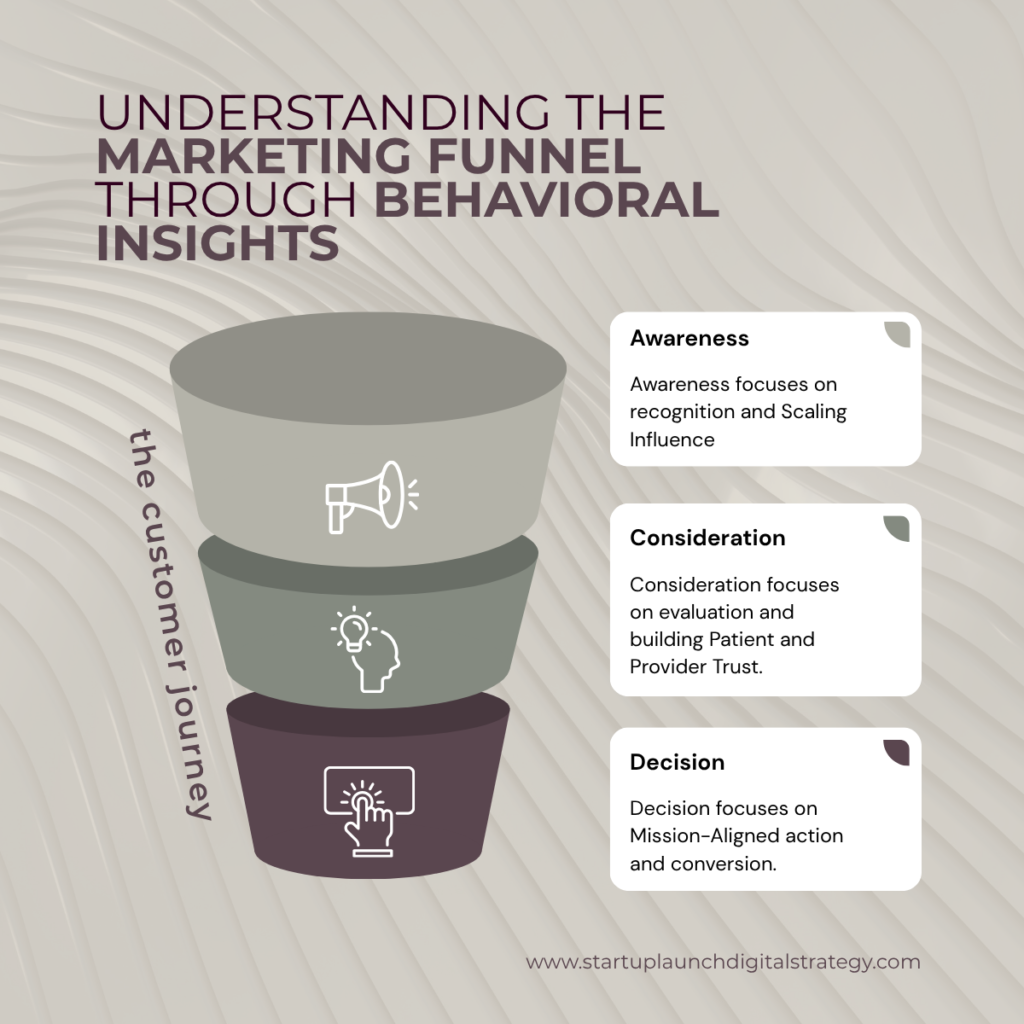
One of the most common failures in digital marketing for healthcare consulting firms is misaligned measurement—judging awareness campaigns by conversions or evaluating conversion campaigns only by impressions. As Semrush (2025) explains, KPIs must directly reflect business objectives to be meaningful. At SLDS, KPI alignment is not optional; it is structural. Every KPI we use maps directly to a stage in the funnel and a specific strategic question that a clinician or public health official would find credible.
The SLDS Measurement System: Five Layers of Authority
At SLDS, KPIs are not just reporting tools; they are a decision system that connects marketing activity to Credibility, Compliance, and Impact. We design frameworks specifically for high-trust industries where Precision matters more than “going viral”.
Layer 1. Awareness— Scaling Influence & Recognition
At the awareness stage, our goal is not raw clicks—it is recognition in credible environments, including search engines and AI systems. For the Expert Strategist, this is about being the “go-to” name when a hospital or state agency has a complex problem.
- AI Brand Mentions: How often AI systems reference your organization.
- AI Citations: Whether authoritative systems include your content in their summaries.
- SERP Rankings: Visibility for high-intent keywords that reflect your professional intellect.
- Organic Visibility Growth: Building a Digital Foundation that acts as a silent salesperson.
In 2026, discovery is no longer limited to Google. AI systems act as intermediaries of trust. We track AI brand safety signals to ensure your mission isn’t misrepresented by hallucinations. Misinformation is a reputational risk that can damage your legal or professional standing instantly (Hasan, 2026).
Layer 2. Consideration Layer —Trust & Engagement Quality
Consideration is where your audience evaluates whether you are Mission-Aligned. ForACOs and Independent Practice Networks, this stage is critical for bridging the gap between complex health data and clear, compliant communication- a core challenge in any value-based care marketing strategy.
- Engagement Rate: quality of interaction rather than raw volume.
- Social Share of Voice (SSoV): Measuring your influence relative to the noise of the market.
- Returning Visitor Rate: A signal of Patient and Provider Loyalty.
- Resource Downloads: Engagement with white papers, clinical guides, or reports.
These KPIs measure intent, not vanity. In healthcare and public health, we also track decision-adjacent behaviors, such as views of provider biographies or location page engagement. These are strong predictors of whether a community member or physician will choose to engage with your network.
Layer 3. Decision — Converting Trust into Action
Decision-stage KPIs measure whether trust turns into action. For the Community Advocate, this is measured by how much you “move the needle” on community health metrics – a cornerstone of any health equity digital strategy.
- Marketing Qualified Leads (MQLs): Identifying interest from relevant stakeholders.
- Sales Qualified Leads (SQLs): Identifying actual intent to partner or seek care.
- Conversion Rate: By channel and campaign, ensuring Precision and Compliance.
- Cost Per Acquisition (CPA): Maintaining efficiency while pursuing Impact.
We separate MQLs and SQLs because not all leads are equal. This distinction helps identify whether your digital strategy is generating “popularity” or actual authority.
Layer 4: Revenue & Attribution Layer — Business Impact
This is where digital strategy for regulated industries connects to organizational health and Public Impact. For healthcare consulting firms, this layer justifies the investment in Brand Identity and SEO.
- Pipeline Contribution: Measuring how digital authority feeds the consulting funnel.
- Revenue Attribution: Understanding which channels produce sustainable clients or patients.
- Customer Lifetime Value (CLV): Especially vital for Retention in independent practices.
- Case Value and Patient Acquisition Cost: Tailoring metrics to the specific industry, whether public health or medical.
Without attribution, organizations cannot optimize responsibly. In high-trust industries, we must understand how revenue is generated to ensure it aligns with the organization’s “why”.
Layer 5: Retention & Lifecycle Layer — Enduring Foundations
High-trust industries are not transactional—they are relational. For Network Connectors, the primary goal is often Retention—keeping member practices engaged and patient bases loyal.
- Churn Rate: Monitoring the loss of member practices or patients.
- Referral Rate: The ultimate sign of Credibility and Trust.
- Client Satisfaction Scores: Ensuring the digital experience mirrors the high level of intellectual service provided.
Why SLDS KPI Systems Work for Mission-Driven Organizations
Our frameworks are built specifically for the audiences we serve — whether you are an Expert Strategist fearing an outdated digital presence or a Community Advocate struggling to drive behavioral change. As a mission-driven digital marketing agency, we prioritize:
- Evidence-Informed Measurement: Every metric is backed by behavioral science.
- Precision and Compliance: We build for long-term credibility, not temporary spikes.
- Mission-Alignment: Your goals are our goals.
Common Mistakes We Eliminate
Most organizations struggle with treating impressions as success or ignoring the long, non-linear decision cycles inherent in healthcare and legal contexts. SLDS resolves this by performing a “Precision Check” before any content or tracking is finalized:
- Does this sound like it belongs in a highly regulated environment?
- Does it offer clarity or just noise?
- Would a Medical Director find this credible?
Frequently Asked Questions
What is a Precision KPI for healthcare organizations?
What is a Precision KPI for healthcare organizations?
A Precision KPI is a performance indicator directly tied to a specific stage in the patient or client journey — not just a measure of activity. For organizations pursuing digital marketing for healthcare consulting firms, Precision KPIs link every content investment to measurable credibility or business outcomes.
How does behavioral science apply to digital marketing KPIs?
Behavioral insights inform which touchpoints drive trust and action in high-stakes decision environments. At SLDS, behavioral insights digital marketing frameworks help regulated-industry clients design measurement systems that reflect how patients, providers, and partners actually make decisions — not just how often they click.
What’s the difference between a fractional CMO and a traditional marketing agency?
A fractional CMO for healthcare consulting provides senior strategic oversight without a full-time executive cost — embedding into your team to build the measurement infrastructure a traditional agency may overlook. SLDS offers this as a core service for regulated industries.
From Metrics to Strategic Clarity
There are thousands of possible metrics, but only a structured subset qualifies as enduring foundations. At SLDS, we design KPI systems that connect every stage of the journey — from awareness to retention — to measurable business and public impact, built for the demands of digital strategy for regulated industries.
Popularity fades. Precision compounds.
Ready to build a KPI system that compounds?
References
Ascarza, E., Schultz, A., & Wernerfelt, N. (2026, March). Growing with Digital Marketing: Evidence, Metrics, and Mistakes (HBS Case 526-040). Harvard Business School. https://online.hbs.edu/blog/post/marketing-kpis
Hasan, R. (2026, January 15). AI Hallucinations in Information Security: A Bibliometric and Grounded Study Perspective. Journal of Information Security and Cybercrimes Research, 8(2). https://neuwark.com/blog/protecting-your-brand-from-ai-hallucinations
Ruler Analytics. (2024). The 2024 Marketing Attribution & KPI Performance Report. Ruler Analytics. https://www.ruleranalytics.com/blog/insight/marketing-challenges/Semrush. (2025).The State of Search 2025: Insights into AI and KPI Alignment. Semrush. https://www.semrush.com/blog/kpi-marketing/